
ASTM Standards
Nitinol is a powerful enabling material for medical device innovation, but its unique properties require careful control, testing, and specification. ASTM standards provide an essential foundation for defining material requirements, improving consistency, and supporting communication across the medical device supply chain.
Shaping the Future of Nitinol Standards
The ongoing revisions to established nitinol standards, along with the development of new specifications for wire, sheet, and strip, represent an important step toward a more complete and practical ASTM standards portfolio for medical device materials.
Through the active participation of Resonetics® experts, Resonetics is helping shape these standards for the benefit of the broader nitinol and medical device community. This work supports a shared goal: advancing high-quality, reliable, and well-characterized nitinol materials for the next generation of medical technologies.
ASTM Nitinol Standards
| ASTM Standard | Primary Purpose | Product Form/Scope | Key Requirements or Measurements | How it Relates to the Others |
|---|---|---|---|---|
| ASTM F2063-18 | Defines the foundational material specification for wrought nickel-titanium shape memory alloys used in medical devices and surgical implants. | Applies to wrought NiTi mill products, including bar, flat rolled products, and tubes containing nominally 54.5–57.0 wt% nickel. Finished cold-worked tube is directed to F2633. | Establishes chemical, physical, mechanical, and metallurgical requirements, including annealed tensile properties such as minimum UTS and elongation. | Serves as the base material standard. Other product-specific standards, including F2633, build from or reference its foundational chemistry and material requirements. |
| ASTM F2516-22 | Defines the tensile test method used to characterize superelastic nitinol behavior. | Applies broadly to superelastic nickel-titanium materials rather than one specific product form. | Provides methods for determining upper plateau strength, lower plateau strength, residual elongation, tensile strength, and elongation. | Acts as the test-method standard. It provides the common language and measurement approach that product specifications can use when defining superelastic performance. |
| ASTM F2633-19 | Defines product-specific requirements for wrought seamless nitinol tube used in medical devices and surgical implants. | Applies to superelastic nickel-titanium tube, nominally 54.5–57.0 wt% nickel, with specified limits for outside diameter and wall thickness. | Sets chemical, mechanical, dimensional, and surface-condition requirements for drawn medical-grade tube, including UTS, uniform elongation, UPS, LPS, and residual elongation. | Bridges the base material specification and the superelastic test method: it relies on F2063 for applicable material requirements and uses F2516-style definitions to set minimum property expectations for tube. |
Nitinol Testing & Analytical Services
Resonetics provides nitinol testing and analytical services to support material selection, device development, product characterization, manufacturing, and failure investigations. Our experienced engineers and metallurgists help customers understand how material properties, processing, and design influence device performance.
Testing capabilities include:
- Material characterization (DSC, BFR, tensile testing, transformation temperatures)
- Corrosion and fatigue testing
- Radial force and mechanical property evaluation
- Optical microscopy, metallography, SEM and EDS analysis
- Inclusion analysis and microstructural characterization
- CT metrology and dimensional analysis
- Fracture and failure analysis
- Production quality and device performance testing
BLOG
October 1, 2026
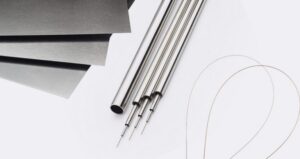
ASTM Nitinol Standards for Medical Devices: Updates to F2063, F2633, and Emerging Specifications
Learn how ASTM Nitinol standards are evolving for medical device materials, including updates to F2063, F2633, and emerging specifications for…
Read More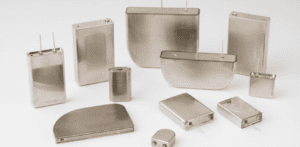
BLOG
August 26, 2026
Why Battery Longevity Matters More Than Capacity in Implantable Medical Devices
When engineers evaluate a battery, it’s natural to focus on day-one performance. Higher capacity, strong power output, and impressive energy density can…
Read More BLOG
August 18, 2026
Implantable Medical Device Batteries 101: How to Choose the Right Power Solution
Choosing an implantable medical device battery involves far more than selecting the highest capacity option. Battery selection can influence device size,…
Read More